Adobe and disability access update

Adobe has been visiting my website. Adobe isn’t happy about me sharing the facts. With all Adobe’s money and lawyers and no other complaints about Adobe claiming that large fonts were supported with CS6, Consumer Affairs won’t pursue false advertising even though I rang Adobe prior to purchase and was told that large fonts would be accessible.

If a number of people complain about Adobe misrepresenting its product then and only then will Consumer Affairs pursue Adobe for false advertising.  If you live in the state of Victoria Australia, and have purchased Adobe products on the understanding that they were fully compatible with Windows 7 including large fonts, then I urge you to contact Consumer Affairs Victoria to lodge a complaint.

I’ve been given a choice: use Microsoft’s magnification window so I can’t use the product properly and can’t see to do layout or accept a refund.

Meta-Muse-ill

This morning on the twitters, Erica Hayes asked, ‘Why must all female villains be superior smart-asses? Can’t we have some real people?’

We went on to discuss how most female villains are bitchy and catty, which emphasises their lack of power and leads to their downfall.

As this idea percolates, I venture further afield…

Life imitates art.  Popular culture leads more than it follows.  Acceptance of homosexual couples has been preceded by TV series and movies normalising acceptance of these couples.  (We have a way to go, so we need more of same.)  Women portrayed as bitchy villainesses and melodramatic characters creating their own dramas in soapies teach women how to gang together to bully a perceived competitor and how to create unity in a group by creating a common enemy.  My daughter used to come home from friends’ houses having watched soapies and learnt how it was done, telling me ‘But it’s so true to life!’

The typical high school in-crowd scenario shows the in-crowd feeling so threatened by the geeks or so vulnerable within their own group that they focus their energy on making the geeks’ lives a living hell in order to shore up their own position.  While this is a cliché, done to fucking death in popular entertainment, there is a lot of truth to this trope.  Unfortunately this particular trope has been cut and pasted into every genre, both in the form of solo villainess and villainess with Greek chorus or minions.  Even many feminist writers resort to feminine politics and bitchiness as plot devices, thus reinforcing the status quo.

A deeply ingrained cultural belief in the subordinate status of women thus disempowers women, teaching and reinforcing their scrabbling over each other for the approval of men (the seductress villain), the insane destroyer of men (‘if I can’t have your approval, I’ll destroy you’, the monstrous feminine villain) and the bitchy villain (I’m not really powerful so I’ll be nasty instead).  Humans are like apes, whose hierarchies are established and maintained with violence, keeping the vulnerable down so that those further up the food chain can feel better about themselves and be groomed by their immediate subordinates.  That’s right, I am saying that the chorus surrounding the Queen B___ is actually picking fleas and grooming her hide.

The conversation that Erica started went on to discuss true power, and how true power can be quiet.  Think of the number of villains – male and female – who have snatched defeat from the jaws of victory because of the ‘big reveal’ when they should have just shot the damn hero and been done with it.

One real-world villain with true power – Hitler – was protected by his subordinates obeying his commands.  There was no need for bitchiness or for Hitler to needle or aggravate anyone. In contrast, female villains are often portrayed as insecure mouthy bitches on heat, too powerless to win via intelligence, technology or skill.  Female protagonists can be written as powerful, especially within a team, where they are sassy, not bitchy, and have great strengths (although too often are in a subordinate role).  Why aren’t female villains part of elite teams, with sassiness or quiet menace emphasising their power?  Or the solo villain spins a web quietly, insidiously… I saw a movie where the big reveal was the president’s wife had the president murdered.  Her artwork seen through the movie looked abstract but at the very end she arranged separate canvases in a group and, seen from the right angle, it was a spider in a web.  The movie recognised the relative lack of power she had as the wife.  I was almost ambivalent at the close: she was a female villain who was getting away with murder and yet I felt some small sympathy for her motives.  I can’t remember the name of the movie but this was probably the best female villain I’ve seen.

Popular culture – books, TV and movies – is not reality but it heavily influences people’s expectations and how they live their lives.  Many relate to TV characters as well as if not better than they relate to people in their lives, spending more time watching TV than they do interacting with real people face to face.  Even the webz, with its distance between user and victim, has changed human interaction.  Once upon a time, being bitchy would have been like a knife fight (up close and personal), or using a gun (backstabbing to friends to injure at a distance).  Now the internet acts like a remote controlled missile where the victim receives a written incendiary device or poison is spread via proxies to contaminate and destroy.  Both scenarios give the villain a comfortable distance, avoiding the need to see the pain and hurt on the victim’s face.

‘By why would people do this?’ you ask.

On the lower slopes of Mount Success, the fight for advantage is bitter, vicious.  Women rake their long, painted nails into the faces of innocent bystanders in their endeavours to claw their way up the bloody pile of bodies.  Cohorts gang together and Queen B___s summon lesser minions to unite in one cause: forcing selected individuals out and down, enabling the victors to climb upon broken backs to reach new heights.  Oblivious to the potential for unity to result in a Tower of Babel reaching for the stars, these gangs prefer the confusion and strife inflicted upon humanity by the legendary god or gods of old.

Unnoticed, some people slip away from the battles being waged in the Fields of Tradition.  They flee alone or with a small group of friends to explore new territory and build sandcastles where no bullies can find them to assault their spires.

Others inadvertently venture into this war-ravaged country only to be assaulted by those on the fringe and ignored by those in the midst of the melee.  Some accidental immigrants lie bruised and bloody about the battlefield, while others escape, seeking safety in shelters built too close to the battlefield.  The more entrepreneurial warmongers see these houses as potential rubble, a foundation for their empire-building.  At the very least, these houses will be used as target practice for archers and ballista commanders defending their borders.

I watch, grief stricken, as I see people injured and lives wasted.  I dream of empires built with collaboration creating true power and wealth for many, while weeping over the empire that, at war with itself, cannot stand.

Life imitates art.  If true bitchiness (catty nastiness) was exposed as the last resort of the weak and contrasted with role models wielding true power, a shift would occur in those who ‘consume that culture’.

Hacker helps disabled mum

Chad Ruble hacked a Microsoft Kinect (the motion sensor for the XBox) so his mum, whose disability prevents her from reading, can send emails.  This video shows Chad’s mum using the kinect and icons to send a simple  email.

The Techcrunch article was short and sweet, but it got me thinking.  If Microsoft are smart, they’ll hire this innovative hacker and take this technological development further.  Using the kinect system and new software with pictures of grocery items, people like Ms Ruble could ‘write’ a shopping list to email to an agency or supermarket, increasing their independence.

This could be a wonderful beginning.

Navigating the maze

To give the below post context: I am disabled, vision impaired.  I have 6/18 functional vision, meaning that what you can probably read at 18 metres I can read at 6.  I’m an albino, so I have photophobia – bright lights blind me – and other charming vision defects with even more impenetrable names.  I was diagnosed when I was 6 months old.  My disability is permanent and untreatable; the only surgery available is cosmetic with risks.

Today has been an exhausting roller coaster ride, but at least it’s gone the right way: down then up.

This morning I had a job capacity assessment with Centrelink (Australia’s Department of Social Security) to determine whether or not a potential employer would be eligible for the wage subsidy if she employed me part-time.  The answer was ‘no’ then it got worse.

Centrelink told me that the uppermost limit for a disability access grant is $1000, and my best hope for more funding would be low-interest loans of less than $1000 each from various sources.  To give you some context: in an administrative assistant (office worker position) I will need a CCTV that will cost around $5000 to $7000 in order to do data entry.  Disability access to a computer is separate.  I sat there and cried.

I couldn’t believe it, I’m stuck on unemployment benefits because I lost my job working for SA Health (the South Australian department of health).  I needed disability access when I was employed there as a Community Health Worker (ASO4), and although the OH&S officer refused to sign off on my induction because I was unable to sit ergonomically without disability access, no disability access was forthcoming.  After a change of manager, the new manager/s decided to bully me into sitting ergonomically at a computer screen without disability access.  When that didn’t work and I sent an email to both co-managers with a request for disability access, I was refused disability access in email then humiliated in a team meeting, which I left in tears. A week or two later my job was advertised; the job selection process was delayed until a student social worker completed her first undergraduate degree about 4 or 5 weeks later, and I was replaced.

I complained: the investigation found that I did not have a disability, I had not declared a disability (in spite of numerous forms and emails showing otherwise), I had not asked for disability access (in spite of email requests and refusals) and this report found that I did not need disability access.  When I pointed out that the middle manager who ‘assessed’ my disability had no medical qualifications, I was ignored.  The Equal Opportunities Commission in South Australia found that I have a disability, I had declared my disability and I requested disability access, but the Equal Opportunities Commission found that I did not ask for disability access enough times.  They didn’t specify how many times SA Health was allowed to refuse disability access.

So here I am, after a period of long-term unemployment doing my damndest to get a job and I’m told by Centrelink that I have to apply for jobs but I won’t get assistance with the barest minimum necessity to enable me to work.  The woman sat there and told me that my employer would be required to fund disability access.  I was absolutely aghast.  No employer is going to take on a disabled employee if that means they’re going to be out of pocket by at least $5K.  I tried to explain this to her.  I told her how employers have abused me in the past for daring to apply for work, how they’ve been aggressive about how I would not be considered if I cost them any money at all.  Centrelink told me that there was no funding for a CCTV and asked me who I thought should pay for it.  As hubby and I are both on unemployment benefits at the moment, getting a loan for a job for which I’d be on probation is out of the question.

I sat there with tears streaming down my face, while Centrelink somewhat aggressively informed me that I am required to apply for jobs regardless of lack of funding for disability access.  I was trying to decide whether the best option was to walk under a train immediately or go through the hell before me, suffering the humiliation of applying for jobs and being abused by employers over and over again, never being considered for a job.  My only consolation is that if hubby gets a job we should be able to extend the mortgage to purchase a CCTV.  Forget replacing the 15 year old car, my only hope of working ever again rests on being able to purchase my own disability access.

I left Centrelink absolutely devastated.

Upon arriving home, I emailed the employer who advertised the job I have been hoping to get, informing her of the bad news regarding both the wage subsidy and the lack of disability access.  I told her that I’d purchase all my own equipment at my expense if I got the job, hoping that it would be possible.

After sending off that email and feeling completely wretched, I decided to ring the Job Access people just in case.  The first person I spoke to gave me some information, which seemed to largely contradict Centrelink, but she was a customer service officer so only able to answer limited queries.  She transferred the call to Camille, my knight in shining armour.

Camille asked me what my disability is, to which I replied that I’m an albino with functional vision of 6/18.  This actually meant something to Camille.  (Now it gets hard to tell the story because I want to start crying again, but in a good way this time.)  Camille talked about needing a medical report, which I have but I don’t have something that says ‘I need disability access’ dated within the last two years.  Back in South Australia I had an ophthalmologist and the Royal Society for the Blind who provided reports to whomever wanted them.  (SA Health received these medical reports but refused to consider these medical reports for their internal investigation, favouring the non-medical middle manager’s assessment of my disability instead.)  Sadly these reports are now more than two years old, and my current reports from Vision Australia and the ophthalmologist here in Melbourne don’t specifically state what kind of disability access I need to work.  Camille said that if I have medical reports that state what my disability is, then they know what I need and can work with that.

Camille wasn’t just talking about spending $5000 on a CCTV, she was talking about spending $10,000 to $12,000 on providing me with disability access.  A voice in my head said, ‘This is too good to be true, they won’t provide you with that kind of access,’ but the news was good enough for me to send a follow up email to the potential employer telling her the basic good news so that she might still seriously consider me for the job.
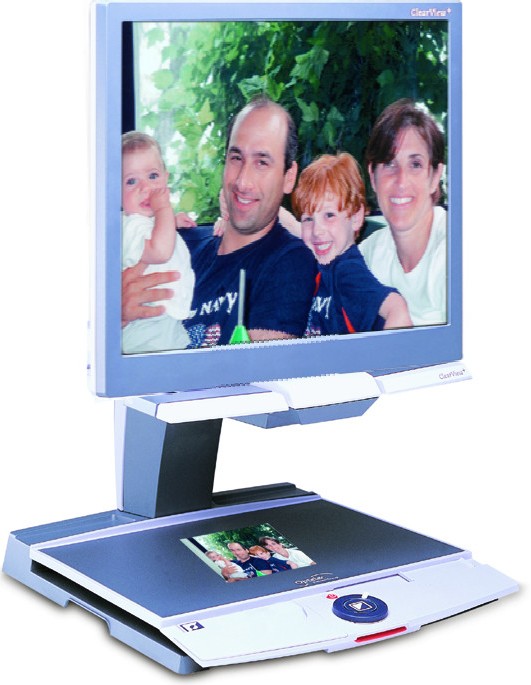
CCTV

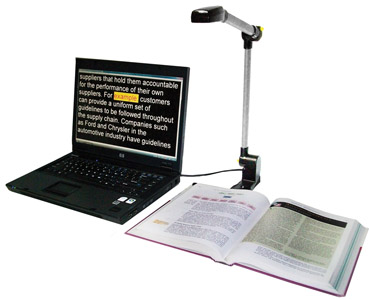
Next port of call was Quantum Technology to look at a CCTV as I hadn’t seen new models in years.  (Above is a slightly older model CCTV: you put the reading material in the tray at the bottom and it’s magnified onto the computer screen.)  If I’m going to get a one-off grant – or pay a shit load for one myself – I want to make damn sure I get the best one possible so it lasts as long as possible.

If Camille is my knight in shining armour, then Trevor of Quantum is the wise man sitting by the crossroads, ready and willing to enlighten travellers prepared to take the time to learn.

Technology has come a long way since the last time I looked – longingly and forlornly – at disability access technology.  CCTVs now come in fully digital models, not even just digital screens but actual digital cameras so that the definition is much better than the one I borrowed for my temp job in Comcare.  In Comcare I had to use a handheld magnifier several times a day because the CCTV I borrowed pixellated and distorted some small text beyond recognition; the CCTVs available now are new and improved.  But it gets better.
Pearl magnifier

Pearl (above) is a little beauty: it’s a portable camera mounted on a stand that takes A4 photos.  These photos are then scanned with optical character recognition (OCR) software and the result displayed on the computer screen.

Yeah, yeah, you say: big bloody deal.

You have no idea.

This OCR software really works for starters.  It can recognise columns of text and interpret the page so it shows on the computer screen as one long column, including italics and font changes, enabling the text to be displayed at varied font sizes.  It can be shown in various display modes including ‘realistic’, black & white, reverse black & white, other colours like yellow text on black background etcetera.  The software can even read the text fairly well, with a choice of voices.  This total package – camera and software – comes to just under $2000.

Another uber-shiny option is a special computer screen with an adjustable stand that gives the option of hooking up the CCTV and the computer (with Pearl or Word or whatever) in dual windows.  These windows are fully customisable:  side by side or one over the other, percentages of the screen are adjustable etcetera.  This would have been absolutely fantastic in my job in Comcare where I was doing data entry from forms under the CCTV beside the computer and turning to the computer…. Let’s just say my shoulders and back started to ache by the end of the day from twisting back and forth all day.  Reach over to adjust the page, look at the one screen for the data entry, then move on… Awesome.

Trevor also showed me a digital electronic magnifier, similar to but better quality than ones I’ve seen before.  This kind of technology I’ve personally put in the ‘fluffy bunnies and rainbows’ basket because I can manage crouched over a hand held magnifier like this one

hand held magnifier

which is not ideal, but as I already own two magnifiers built along these principles, it’s a hell of a lot cheaper.

We also looked at Zoomtext, which I purchased and used myself for some time but that version – version 6 – caused my computer to crash so I found alternative means of using the computer (even if I haven’t been sitting fully ergonomically, I have been getting by).  Now Zoomtext is up to version 10 and is a lot better.

I was running up an awful bill in my head, trying to work out which pieces of disability access technology I would select if given a choice.  The total package was definitely coming in at around $10,000 to $12,000, the figure Camille had cited, but I just didn’t believe that I would get that amount of funding.

Trevor said that what he had shown us was the normal starting package for a vision impaired person starting work.  

Of course the workplace modifications people don’t want to purchase unnecessary equipment and workflows need to function so that I am at least as efficient as a non-disabled person in the same job, but apparently this is the normal package for someone like me.

I still find it extremely difficult to believe.  Firstly, it’s difficult to believe that the government would fork out all that money to get me into a job after SA Health (state government) trashed my career so utterly and completely just because I asked for disability access.  Secondly I find it difficult to believe that, after all these years, I’ll get a job at all.

The icing on the cake was Trevor telling me that I could get a brief trial period of the technology in the workplace because once the workplace modifications people have signed off on it, I can’t get any replacements or new technology for a whole year.

Wha-at?!

Yes, a whole year.

I had assumed that no further technology would be forthcoming ever, not even when expensive equipment died or it’d be at least 5 or 7 or 10 years before new technology would be funded.  Nope, apparently it’s annual.  If I got this kind of package I wouldn’t need much if anything for years, but knowing that modest funding is available for replacements or change of workflows is reassuring – if only I could really relax and believe it.

I feel like Alice, who’s had this awful, prolonged fall down the rabbit hole, landing with a bruising thump.  Feeling quite battered and traumatised, slowly, apprehensively, I pick myself up and look around.  I spy cake on the table with a note saying ‘Eat me.’  If I eat the cake, will it be more poison or will it be the means of my escape into Wonderland where I can be as ‘normal’ as the next person?

Return to home page
 

St George and the Dragon

Monday morning at 9am I arrived at Trotters in the Trough [not their real name], a company who is intent on receiving government funding but not fulfilling the government’s minimum service requirements while doing so.  The woman with whom I had the appointment was late – again – so I sat in a row of seats against the wall near the door while I waited.  A young man walked in – let’s call him St George – and stood nearby, about a metre away from me, standing just in front of the row of chairs.  George was noticeably short for a stormtrooper, dressed in light tan trousers, a shirt and a black jumper.  I thought to myself that if George didn’t go up to the counter for assistance that he’d never be served but I was mistaken.

Dragon [not her real name] sallied forth out of her cave; tall, not much below 6 feet in her heels, short hair dyed a hopeful strawberry blonde, wearing casual office clothes and a fair amount of makeup instead of armoured scales.  Dragon walked straight up to George, towering over him inside the usual 3 feet that is polite professional personal space.  Dragon declared that George’s appointment had been cancelled forthwith and he was to leave the office.

George slumped, his shoulders curling downwards like a wilted plant, but he refused to leave.  He spoke quietly, just barely loudly enough that I could hear him so close by.  George explained that he was there to look for work and he had an appointment that he had to keep.  Dragon informed George that the woman he was to see was off sick and that Dragon was not prepared to allow him to see anyone else, nor even to arrange a replacement appointment that day.  Again, Dragon demanded George leave.  With the patience of a saint, George submitted to this brow-beating from a Dragon towering over him inside his personal space.  Determined to weather the flaming ahead, George persevered; using very few words he indicated he was there to look for work.

Incensed, Dragon inhaled, preparing her flaming breath for attack no matter the witnesses, no matter the consequences.  Dragon belched flame, accusing George of working and looking for work at the same time, stating that this is illegal and they will not help him.  George quietly told her that he only got a day or two days’ work here and there and that he can’t live on that, so he needs to look for work.  Dragon then looked over at me, realising that she’d just violated the Privacy Act – apparently only humans need comply – in front of a qualified counsellor who has had detailed knowledge of how and why what she’d done is illegal.  Looking back at poor hapless George, Dragon accused George of claiming social security benefits illegally while on a low income but it was never clear whether he had claimed full benefits without declaring a part-time casual job or whether she was just covering herself.

Caught in the act, Dragon briefly became more conciliatory, telling George that the woman with whom he had an appointment was pregnant and on leave, so they didn’t know when he would get a replacement appointment and they’d get back to him, perhaps tomorrow.  George still refused to leave, saying he was there to look for work.

Belching flame once more, Dragon continued to attack while looking between George and I.  Dragon claimed that she earns her money working for Trotters in the Trough, and pays her taxes, denouncing George for wanting to look for work so that he could get off social security benefits.  This agency apparently earns its money from the government, providing a service and is constrained against providing a service for George, according to Dragon.  George quietly pointed out that he had an appointment with Trotters in the Trough to meet Centrelink’s (department of social security) requirements to claim his benefit, and he was here to do so.  Dragon inhaled deeply once more, preparing to flame George to a crisp.

At that moment Tardy, my consistently late-for-work, prompt-to-leave, disability employment services consultant, called me in to her office.  I don’t know what happened next in the foyer, but Dragon joined us a couple of minutes later.  Within minutes I had both Tardy and Dragon flaming me, telling me I could not apply to replace the woman who was on maternity leave, whose clients are being neglected: apparently my qualifications and experience are insufficient to be allowed to apply for the position that they have been unable to fill.  Dragon also informed me that I would not be permitted to apply for counselling jobs, and that I should be grateful not to be forced into a factory production line or packaging job.  Dragon told me that she would graciously allow me to apply for data entry work and that is all.

I couldn’t believe my ears: this violation of the Privacy Act, the garbled nonsense and feeble excuses coming out of Dragon’s mouth all because two of their clients wanted to look for work.  This foreshadowed what was to come for me in the following days.

Homophobic Hypocrisy

Lately there has been a lot of discussion in social media about homosexuality and equal rights particularly pertaining to the right to marry.  I’ve been flamed previously for making pro-Christian comments and for making pro-equality statements, so here I am coming out of the closet on my views.

I am almost ashamed to admit it, but I’m a Christian of sorts.  My beliefs aren’t orthodox and I’ve had lots of conflict with church leaders over the years.  For example, I believe:
*  God is not male, God is a spirit who ‘created humankind in [God's] own image, male and female [God] created them‘, so God is the best of both sexes and GOD DOES NOT HAVE A PENIS.  (NB: ‘created’ means helped or guided evolution; the Bible was written by a primitive people in more primitive times)
*  Jesus said the most important commandments were to love God and love one another.  Jesus said don’t judge others or you’ll be judged by the same standard you apply to other people: in other words, before you start  meddling in other people’s lives, sort out your own shit.  This includes ensuring no leader in the church is a paedophile, committing adultery, fornication, abusing spouse or children, all church leaders should abide by laws such as paying the correct amount of tax and driving within the speed limit etc.
*  women are created equal to men

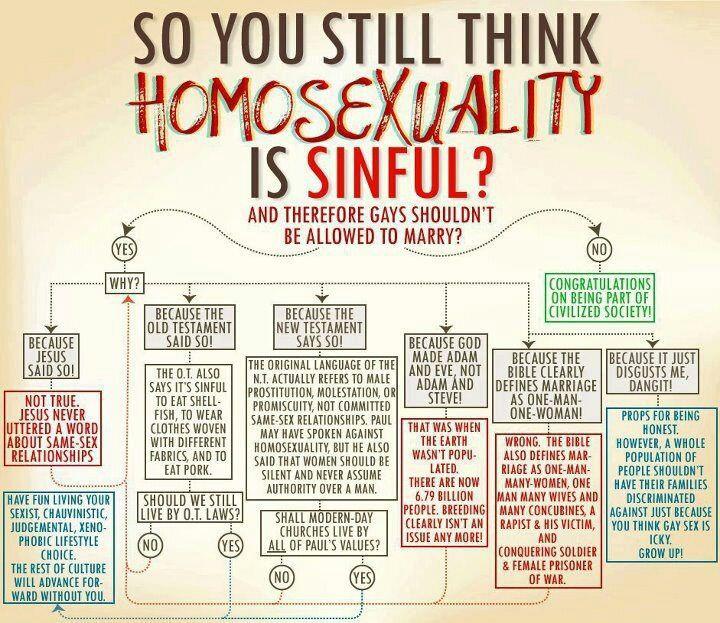
I linked this image from George Takei on facebook today.

George Takei pro-equality flow chart

The conversation that followed went like this:
Stephen: Not accurate, but I guess you figure those that disagree won’t comment.
Me: what are you disagreeing with specifically? In Corinthians Paul says women shouldn’t have short hair and they should keep their hair covered or they would bring condemnation onto themselves and their church. This was cultural: a woman with short hair in that culture was assumed to have been caught in prostitution. Covering themselves was either referring to wearing something on their heads (cultural) or being ‘under headship’ i.e. the authority of a man. The latter was cultural as well, and the necessity of which is effectively contradicted in a number of places in the Bible. If you’re going to argue that women are still supposed to be subordinate to men, this conversation is over.
Stephen:  I’m not going to get into this here. It’s designed to appear to be addressing concerns Christians have. It doesn’t. It’s made to look like it offers reasonable alternatives from the Bible. It doesn’t. It’s having a go at people who believe different than the author. That is all.
Me:  so you’re against allowing non-Christian homosexuals to marry.
Stephen: ”I’m not going to get into this here.” I’ve commented on a post on my wall. One I disagree with. I’ll leave it there.
So Stephen commented on my wall in a passive-aggressive manner and then, instead of entering into a fair argument on my wall where people who agree with both sides may enter the argument, he took the argument to his wall where the argument would predominantly be one-sided.

I’ve known Stephen for 22 years.  I know he knows church leaders who have committed tax fraud: one elder instructed a pastor in how to claim his wife’s non-business sports care and their entire petrol usage for 2 sports cars as a business expense.  Other people we both know include a few couples on the youth committee who had sex before marriage while in leadership (they remained in leadership if sufficiently well connected within the church).  A pastor we both know told a battered wife that her husband ‘wouldn’t feel the need to hit [her] if [she was] a better wife.’  I know many worse stories involving Christians in leadership who have made homophobic statements, but I’m trying to only think of people that Stephen and I both know.

While I was a member of the church we shared, a former pastor attended a course on ethics at the bible college.  In the first lesson that former pastor told everyone that he believed that there was a special place in hell for homosexuals.  I was the first person to step up and challenge him, followed shortly afterwards by two other people who went on to become leaders in the church (she was the daughter of another pastor, he became her husband; this is why they got away with this kind of behaviour).  The lecturer did not intervene for some time, and when he did intervene it was only to close down the argument.

In hindsight I should have dropped out of that course immediately, because it set the tone for a hellish year, including setting a precedent for another student abusing me for an hour and a half for an assignment where I presented on equality of the sexes; that student also approached the principle of the school demanding that I be expelled.  The principle had made a point of attending my oral presentation and informed that student that the college agreed with my position on that topic.  Not all Christians in leadership have superior entitlement issues.

After years in churches where homophobia was the norm, one of my favourite people came out of the closet to me.  Most of our friends didn’t know he was gay but we got on so well he even approached me – very gently – about possibly having a child for him and his partner.  I couldn’t carry a child and give it away so I said no.  This didn’t impact on our friendship at all; it was only when my family and I moved to Adelaide and he moved to Sydney that we lost touch.

There were so many things this friend said that got me thinking.  Like the above image from George, I came to the conclusion that the Bible was anti-homosexual in an era when diversity of the gene pool was important.  Even so, the Bible acknowledges that homosexuality existed even from ancient times.

The apostle Paul made statements against homosexuality: this is fact.  It is also fact that Paul was also against heterosexual relationships.  Paul’s ideal was for no sexual relationship whatsoever, but if people were so weak that they absolutely had to have sex then he wanted people to be married.

1 Corinthians 7:1 Now for the matters you wrote about: “It is good for a man not to have sexual relations with a woman.” 2 But since sexual immorality is occurring, each man should have sexual relations with his own wife, and each woman with her own husband…. 6 I say this as a concession, not as a command. 7 I wish that all of you were as I am [celibate].  

Chapter 7 continues on, talking about Paul’s recommendation for people to remain single but to get married if they really want sex.  Paul deserted his wife to hunt down and destroy Christians then converted to Christianity but didn’t return to his wife, he stayed celibate.  He then tells other people how to live their lives including advocating celibacy as the better path.

Paul’s arguments are entirely invalid for people who are not Christians who also do not live in Ancient Rome as Paul was talking to Christians about what Christians should do.  Paul wasn’t telling Christians to dictate to their broader culture.  Homosexuality was accepted practice in Paul’s time and yet he doesn’t tell Christians to go out and campaign against homosexuality, denying homosexuals equal rights.  Paul talks about evangelism – converting people to Christianity – and about how Christians should live in that day and age.  Period.

Jesus said of the woman caught in adultery, ‘Let he who is without sin cast the first stone.’  The woman caught in adultery is an example of non-conformist sexuality in Jesus’ time.  Once everyone who came to condemn the woman had left, Jesus said to the woman that he did not condemn her either.  Christians who condemn consenting adults are acting against Jesus’ better example, hypocritically proclaiming self-righteousness.  Christians who call upon Paul’s teaching to support anti-homosexual campaigns should also be celibate as Paul recommended.

Christians taking these aggressive accusatory stances are dividing communities while behaving like Pharisees and Sadducees.  Instead of judging others whilst at fault themselves, how about extending the hand of friendship and working towards a more loving, accepting, world?

What did Jesus do?

Almighty Johnsons, Blood Storm and Droidfriend

This morning I interviewed Emmett Skilton and Tim Balme from The Almighty Johnsons.  The Almighty Johnsons is a Kiwi urban fantasy comedy TV series from New Zealand, currently with a 4.5 star rating on AmazonUK.

Listeners have a choice between MP3 (audio only) and MP4 (video) versions of the interview, both versions found here.

I first heard of The Almighty Johnsons from Boxcutters, who are huge fans: John Richards says he’s even asked if he could write for them.  Boxcutters has featured the Almighty Johnsons twice: EP 288: THE LIGHT SIDE OF 2011 and EP 267: ALMIGHTY JOHNSONS, CHANNEL 9 ADVERTISING.  After hearing about the Almighty Johnsons a couple of times from a few different sources, I decided I must watch this series.  I searched online and found the production company’s store selling season 1 late last year.  It arrived on a Friday.  On Saturday night about 9pm hubby and I sat down to start watching it.  We loved it so much we had to drag ourselves off to bed at 3am.  Even then, it was only exhaustion that prevented us from finishing the series that night.  We finished watching the entire series the next day.

I must confess I’ve been nearly as evangelical about the Almighty Johnsons as John Richards; Helen Lowe (award-winning Kiwi fantasy author) said she hadn’t really watched it – she’d only seen one episode – so I converted her!  Helen is now a fan.

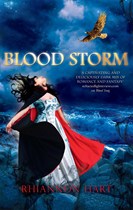
Blood Storm cover

Rhiannon Hart’s novel Blood Storm is launched today; Rhiannon and I chatted last night.  The interview is available as an MP3 podcast.

The above Filky goodness – Droidfriend – was uploaded overnight, brought to you by Teddiefilms, the same guys who did Star Wars that I used to know, which, in my opinion, is better than the original Somebody that I used to know.

Shades of sex

If you haven’t been living under a rock lately, you’re aware of the new ‘must read’ book, 50 Shades of Grey, a novel about a wealthy white male, Christian Grey, who uses and abuses the female protagonist, Anastasia Steele.  Much of the discussion I’ve seen centres around the poor quality of prose, the lack of imagination including repetition (bend over this piece of expensive furniture, this time bend over a different piece of expensive furniture), not to mention the abusive nature of the relationship.  Questions are being asked: is this novel’s popularity due to poor education? If so, who is responsible?  Are writers responsible?

The Sponsored Lady seems to think the point of 50 Shades was a novel to provide extra stimulus for masturbation.   Having been promised non-traditional sex (e.g. anal sex), Lady is bitterly disappointed.  Add to that empty promise the unimaginative forms and low-level language of the female protagonist who is, allegedly, a Literary major, topped with Grey’s lack of knowledge of wine, and Lady is disgusted, let down like the promise of alcohol (it provokes the desire, but takes away from the performance).

Why, then, is 50 Shades so popular?

In times of economic depression, people turn to forms of escapism to cope, whether it be gambling (lotto sales tend to increase at these times, enabling people’s dreams), drugs or other forms of entertainment.  The romance section of publishing has been booming, catering largely but not solely to women.

Women’s liberation saw a swing towards freedom of expression for women.  Germaine Greer exposed key societal attitudes towards women eloquently when she penned the title Damned Whores and God’s Police.  Horror movies present women as either the virgin or the whore; the whore is inevitably mutilated for her sins while the virgin may be the pure sacrifice or her purity may be rewarded by escaping the awful deaths to which her friends succumb (see this blog by Kirstyn McDermott .)

In recent times the pendulum has swung back towards traditional patriarchy, almost an attitude of blaming women’s lib for the loss of the ‘good ol’ days’.  This backlash against women’s lib has increased the sexualisation and objectification of women coupled with political moves to return women to ‘their place in the home’ and legislate increasing control over women’s reproductive systems.   Women are still damned if they do, damned if they don’t.  Novels are a much safer vehicle for sexual stimulation, with or without self-stimulation, hence the proliferation of erotica aimed at women.

But why is this particular book a runaway success?

50 Shades was extraordinarily well-marketed prior to its release.  Ellen Degeneres was allegedly asked to record the audio book version of 50 Shades, but ‘things didn’t go according to plan’: Ellen coquettishly refused to read portions of the book aloud, skipping to other salacious bits, pulling out props, etcetera.  This YouTube clip has over 2.6 million views today.    In a market that laps up romance, including paranormal romance and ‘romance’ in abusive or co-dependent relationships (e.g. Twilight), a savvy publicist launched what is apparently poorly written copy amid huge fanfare.  50 Shades is so popular it’s acceptable for people to read it on the train to work without concealing the cover.  It’s a must-read to the point that certain people in my twitter feed have succumbed to purchase 50 Shades and begin reading it before throwing it down in disgust.

50 Shades couples the current patriarchal attitudes towards women with eroticism: Anastasia is submissive in these sexual encounters.  This is Twilight for a slightly more mature audience.  The problem with women being submissive and dependent is twofold: it is harmful for women and their relationships.  A submissive, dependent woman is more likely to suffer from depression (see Martin Seligman on Learned Helplessness).

The proliferation of werewolf and vampire romantic fiction set the stage for 50 Shades by seeding acceptance of inequality and even abuse in relationships.  50 Shades isn’t the end of this trend.  Writers can write about healthy relationships, seductively describing explicit erotic scenes, but those who’ve internalised the messages of Twilight and 50 Shades will stay away in droves because they won’t identify with the characters.

Return to home page

Adobe and access part III

Previous blogs on the topic of Adobe CS6, the standard text & icon settings and my attempts to get disability access to a product that was represented by Adobe and Microsoft as being fully compatible with Windows 7:
Adobe and disability access part I
Adobe and disability access part II 

Yesterday I received this email from Adobe:

Dear Ms. Haynes, 

I have read your email below and have spoken with Russell about your case previously. I will need to confer with the Adobe legal and product teams in the United States to determine appropriate course of action.  

Please be advised that we treat all such requests seriously and will advise you in due course as to the outcome of our investigations.

 With Best Regards,
 Michael 
–
Michael Savanis
Director, Account Management & Customer Care, Asia Pacific
Adobe

As a lot of non-disabled people have been complaining online about Adobe’s text sizes when running CS6 with Windows 7, I can’t understand why Adobe is consulting with lawyers instead of fixing the problem.  Although this is a disability access issue because I am vision impaired, it isn’t only a disability access issue, it’s a user interface issue for ‘normal’ people too.

In order to run CS6 in Windows 7, I’ve had to go into properties and disable display scaling on high DPI settings under the compatibility tab.  Adobe failed to declare this lack of compatibility in the advertising or on the phone prior to purchase of the product.

Adobe has claimed (over the phone) that disability access has been provided because it’s possible to run Windows’ magnification window.  The problem with this is that I would lose half my visual real estate by having InDesign running in two windows: one window each for the native version and the magnified version.  I cannot run two monitors to compensate for this loss of visual real estate as my current monitor sits at the front of my desk so I can see it; any other monitor would be too far away and at too great an angle to be ergonomically viable.  I might be able to operate basic functions using this dual window operation, but layout would be impossible.  In the magnification window only a portion of pages would be visible.  In the other window I’d either have only a portion of pages visible or, if I reduced the magnification sufficiently, I could have the entire page visible – at such low magnification that I would not be able to see it well enough to do layout.  It wouldn’t be possible to both see the layout and see Adobe’s text & icons to make necessary changes.  I’ve requested Adobe field-test their recommended solution and that they provide a video instruction guide to show how I’m supposed to make this solution viable.

So far helpful people have recommended I look at the following alternative desktop publishers: Microsoft Word, Open Office, Scrivener, Quark and Scribus, plus Gimp for image editing, as well as reverting to my previous edition of InDesign.

I have been creating InDesign using the CS3 version but I can’t import links: the links menu/list is tiny (similar in size or smaller than Adobe CS6′s default text size of less than 3mm on my 26″ monitor), which is why a number of links in issues 1 to 8 are broken – I haven’t been able to see well enough to make sure that Adobe has linked correctly.  It’s also getting harder to work with such out-of-date software as I can’t import or place new file types, I can’t create ePub or Mobi versions, I can’t… you get the idea.  I still have access to InDesign CS3, so that is what I’ll use for DMF10.  I have no idea what I’ll do after that, as I’ve spent $1063 on upgrading to a product that is not currently viable.

I deeply appreciate everyone’s suggestions.  If anyone else has suggestions, feel free to comment in the replies.  My husband and I can look into the various options available, and hopefully come up with something that is viable in the longer term.

Return to home page

Adobe and disability access part II

Two days ago I posted about my poor experience with Adobe, without even going into detail like how Adobe made it extremely difficult to get any technical support.  Adobe has repeatedly claimed that I’d purchased the product from a reseller (not true) and this was why I was unable to log in to Adobe’s website to get technical support.

To recap: Adobe InDesign and other products in the cut-down CS6 package I purchased recently don’t work at reasonable font sizes using Windows 7.  People in forums without disabilities have been making accusations of Adobe failing to cater to the ‘over 40 market’ because the text sizes and icons are so small.

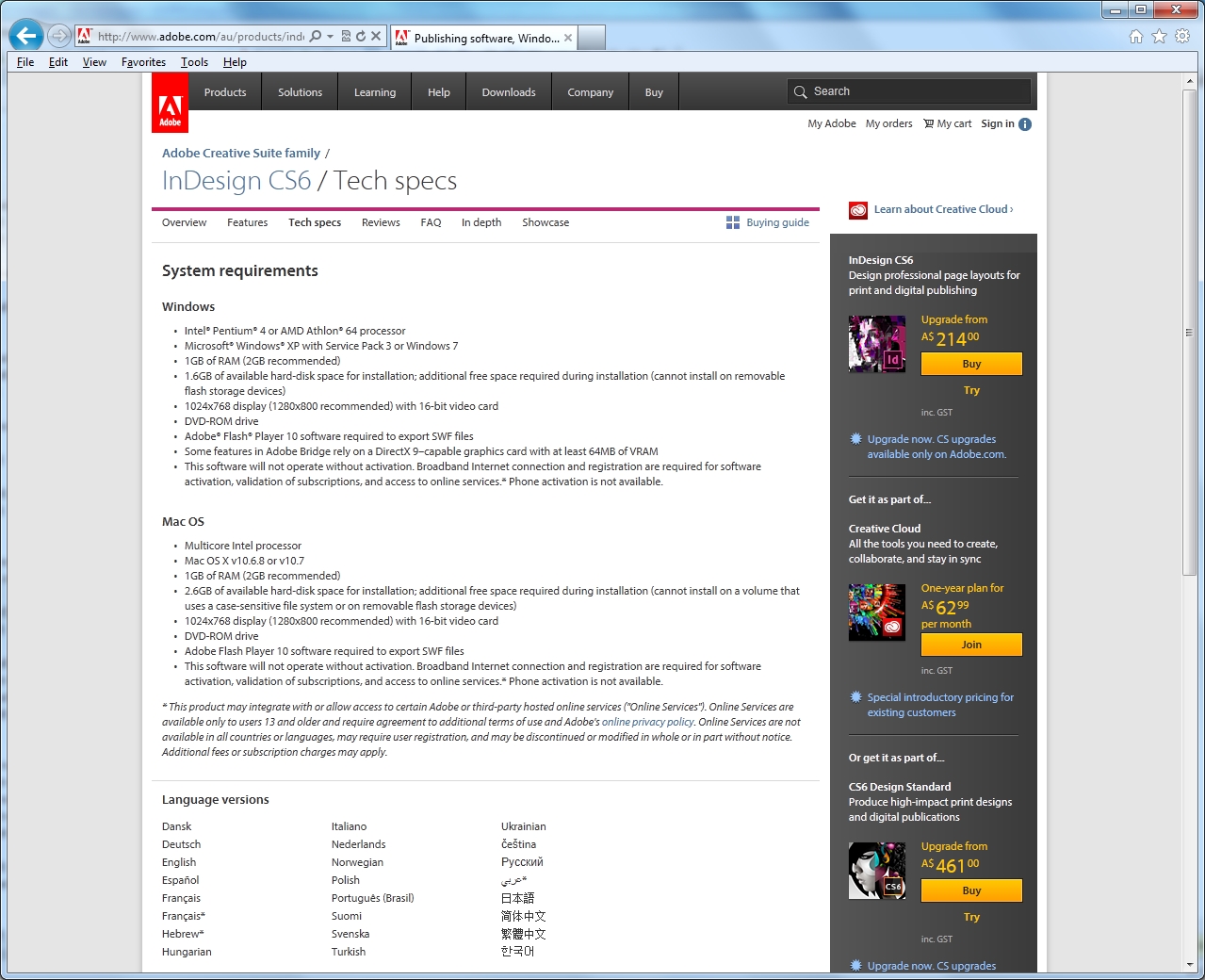
Below is a screen shot of Adobe’s website showing the specifications for InDesign, which includes compatibility with Windows 7.  There are no caveats stating that it is not possible to use Microsoft’s font enlargement features.  Compatibility with Microsoft’s new disability access features were a major influence in choosing to upgrade to CS6; had I known that this ‘upgrade’ was actually a downgrade in terms of access, I would not have purchased this product.

Adobe has decided that text for menus etc that is less than 3mm high on a 26″ monitor (I used a ruler) is adequate; this is the size of the largest font that Photoshop will allow.  I don’t know if Photoshop is actually working properly or not, so I don’t know if I should set the text to a smaller size.  Here is a screen shot of Photoshop as it is currently set up:

adobe photoshop demo

adobe photoshop demo

Compare this with a screen shot of Microsoft Word as I currently have it set up

While Word is by no means a perfect set up for me, I can use Word with its larger font settings.  In order to create the above two documents I took screen shots, pasted them into Word, converted to PDF, opened the PDFs in Photoshop, cropped and saved them as jpgs.  Even that little bit of squinting at the screen with my nose practically touching the monitor while using Photoshop for less than five minutes has given me eyestrain so badly it’s not just my eyes but across the bridge of my nose and a headache as well.  If InDesign is set to font sizes that small, there is no way I can use it to develop new issues of Dark Matter.

Adobe’s solution? Cut my visual real estate in half by using Microsoft’s magnification window.  So, in order to compensate for Adobe’s failure to comply with its own advertising, I’m supposed to cope with only half my monitor dedicated to the program I’m using.  I won’t be able to see layouts at all because the magnification window will only show portions and the other window will either also only show portions of a page or it will be so small I won’t be able to see it.

I use the magnification window on my laptop for basic tasks like watching what I type as I touch-type, but even for reading this is not a satisfactory solution.  Adobe has decided, probably without field testing, that this is the only solution they are willing to allow a disabled person in spite of their advertising and in spite of the verbal assurances I received when I rang Adobe before purchasing the product.

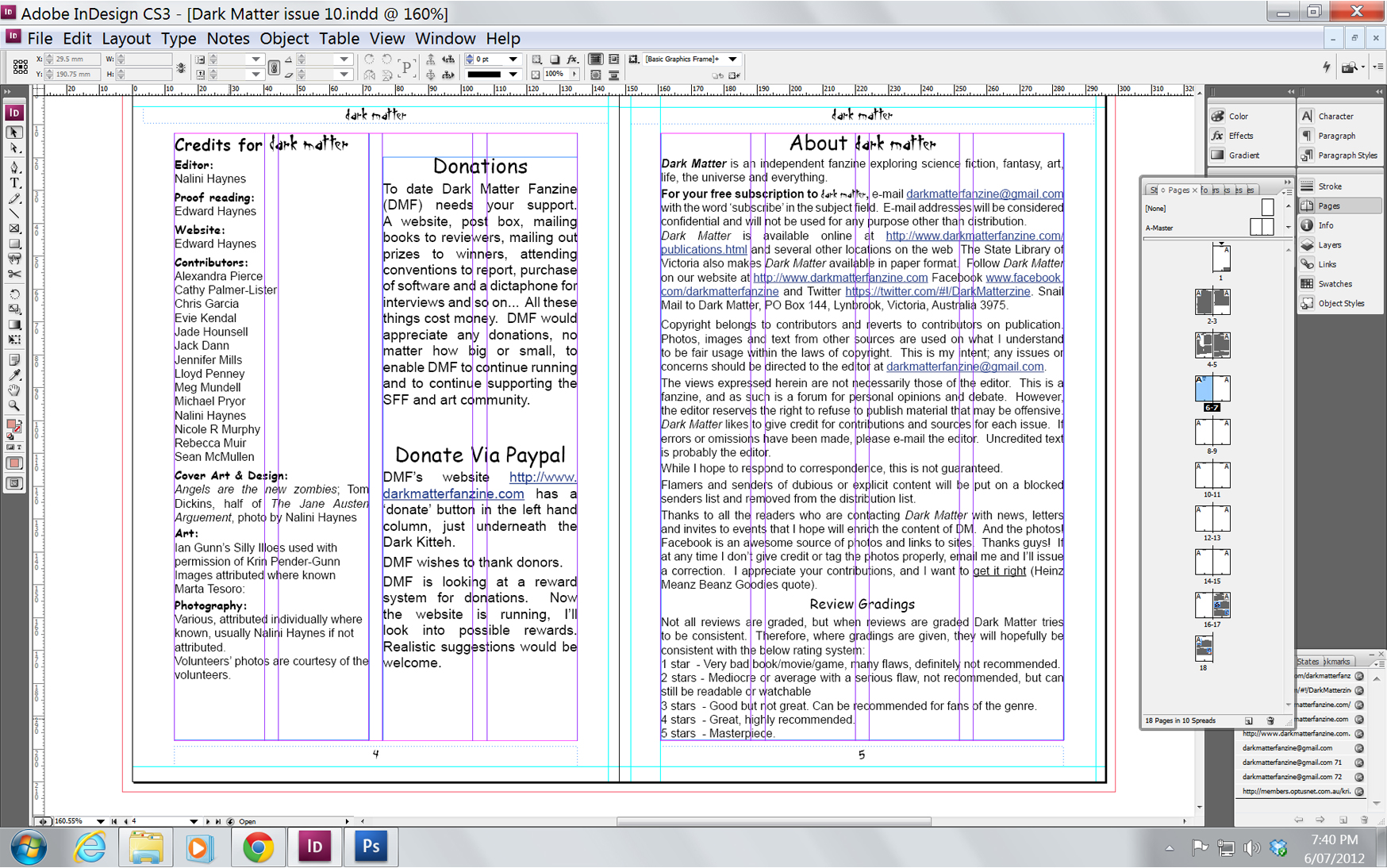
UPDATE:  Adobe InDesign CS3 snapshot.  Notice how Adobe have downgraded font sizes between CS3 and CS6.  CS3 is far from perfect: much of the software, e.g. required text necessary to insert links, is tiny.  This is why many links are broken in Dark Matter issues 1 to 8; the minion is repairing them when he has time, and these issues will be replaced.  Adobe advertising claimed compatibility with Windows 7, which should have resulted in larger font sizes all round instead of smaller.

Adobe InDesign CS3 snapshot

Adobe InDesign CS3 snapshot

Return to home page